From the substation to the energy review
PLCGateway speaks the protocols of substations, feeders and building controllers, draws them with the symbols electricians and HVAC engineers expect, and turns meter readings into the figures an ISO 50001 energy management system needs: consumption per carrier, significant energy uses, energy performance indicators and savings against a baseline. Energy management is a licensed module of PLCGateway SCADA and Embedded; the trial includes it.
Protocols for energy and buildings
Native drivers, tested against reference devices, with browsing where the protocol allows it. Profinet and EtherCAT devices are reached through their PLC, OPC UA or Modbus gateway.
IEC 60870-5-104
Substations and RTUs: interrogation, time-tagged points, measured values and counters, single, double and setpoint commands.
IEC 61850 MMS
Protection relays and bay controllers: logical nodes by name, data model browsing, select-before-operate controls.
DNP3
Power and water outstations: class polls, unsolicited events, counters, control relay and analog output commands.
BACnet/IP
HVAC and building controllers: Who-Is discovery, read and write with priorities, object list browsing.
Single-line diagrams and plant rooms
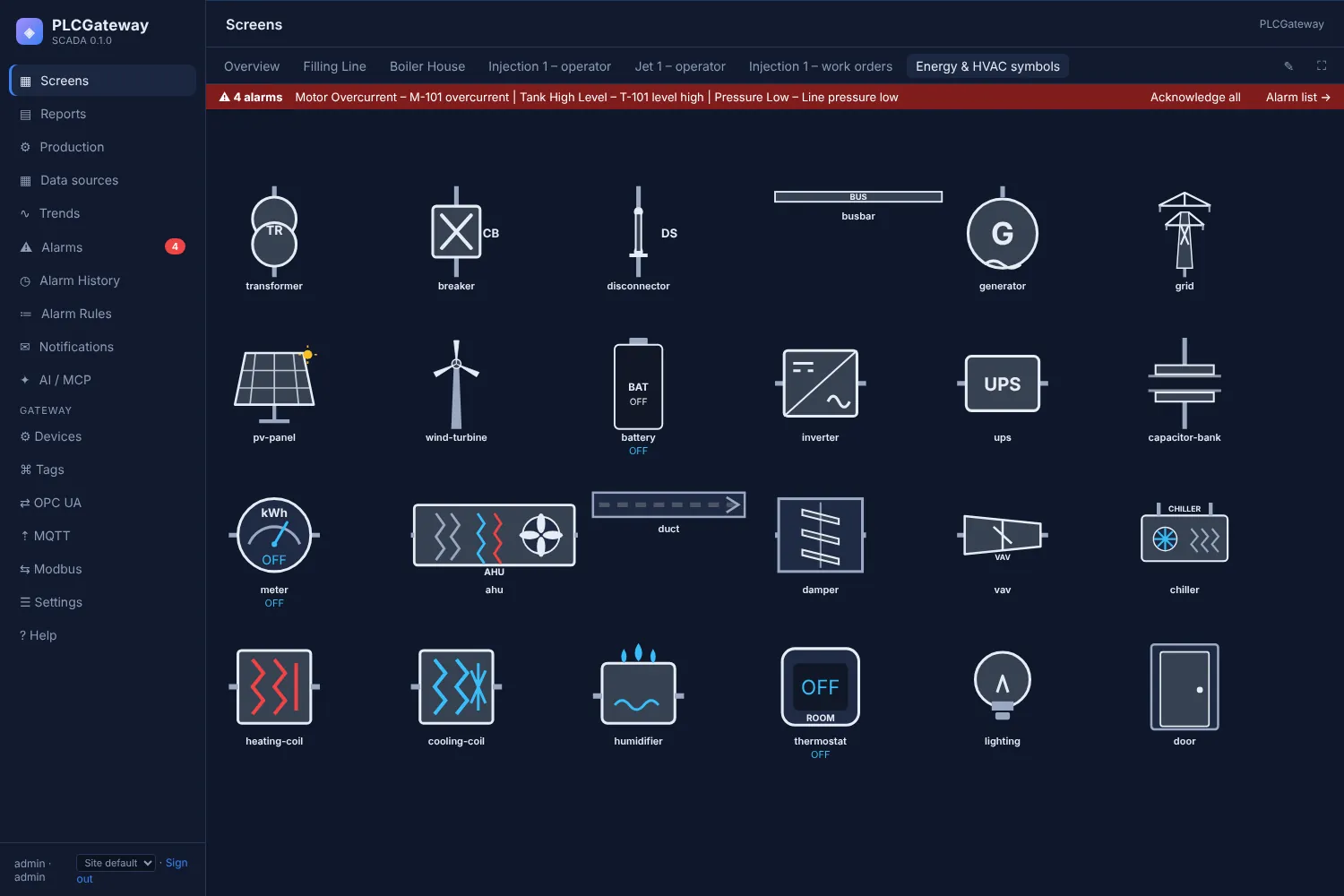
The symbol library carries transformers, breakers, disconnectors, busbars, generators, grid connections, PV panels, wind turbines, batteries, inverters, UPS, capacitor banks and meters for the electrical side, and air handling units, ducts, dampers, VAV boxes, chillers, heating and cooling coils, humidifiers, thermostats, lighting and doors for the building side. Each symbol binds its state, fill, value and colour to live values and works in the browser and on embedded panels alike.
- Breaker and disconnector positions with colour by state
- Flow animation on busbars and ducts
- Values and units shown next to the symbol
Energy meters, costs and significant energy uses
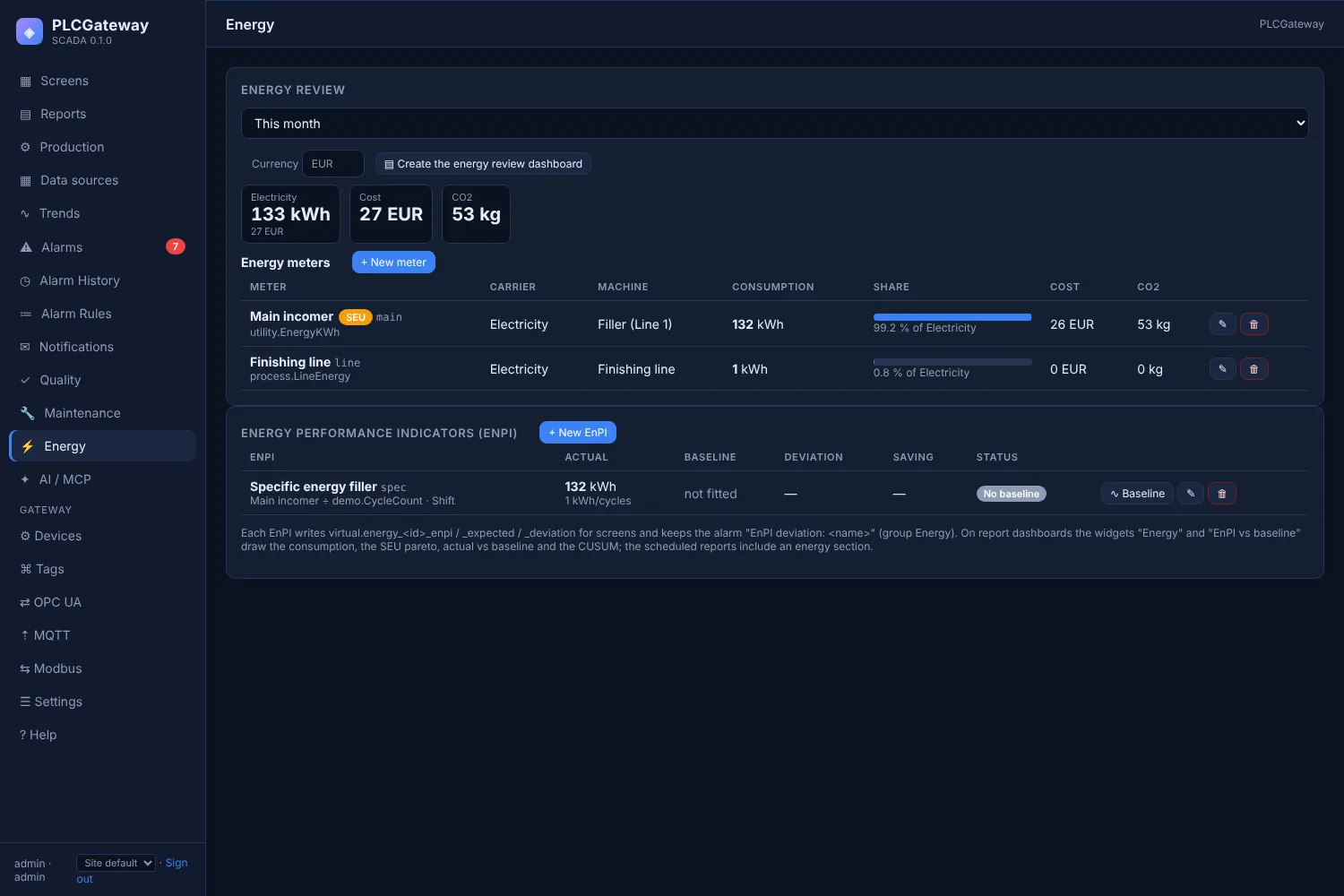
A meter is a kWh, m³ or t totaliser or a kW / m³/h rate signal on any protocol, with its energy carrier, cost per unit and CO2 factor. The energy review shows consumption per meter and per carrier, shares, costs and emissions for this month, the last 30 days or the year, and ranks the meters in a pareto so the significant energy uses are visible at a glance.
- Electricity, gas, steam, water, compressed air, heat and fuel
- Reset-aware counter increases and time integrals of rates
- Calendar periods: shift, day, week, month
EnPIs with a baseline, savings and CUSUM
An energy performance indicator relates the energy of a meter to a driver per period: the produced quantity of a machine from the production model, a counter, the integral of a rate or an average such as degree days. Over a reference period PLCGateway fits the baseline E = a + b × driver with its r², then measures every later period against it: expected energy, saving, cumulative sum of savings, deviation and target.
- Virtual tags for the running period on screens and in reports
- Alarm when the energy exceeds the baseline by more than the allowed percentage
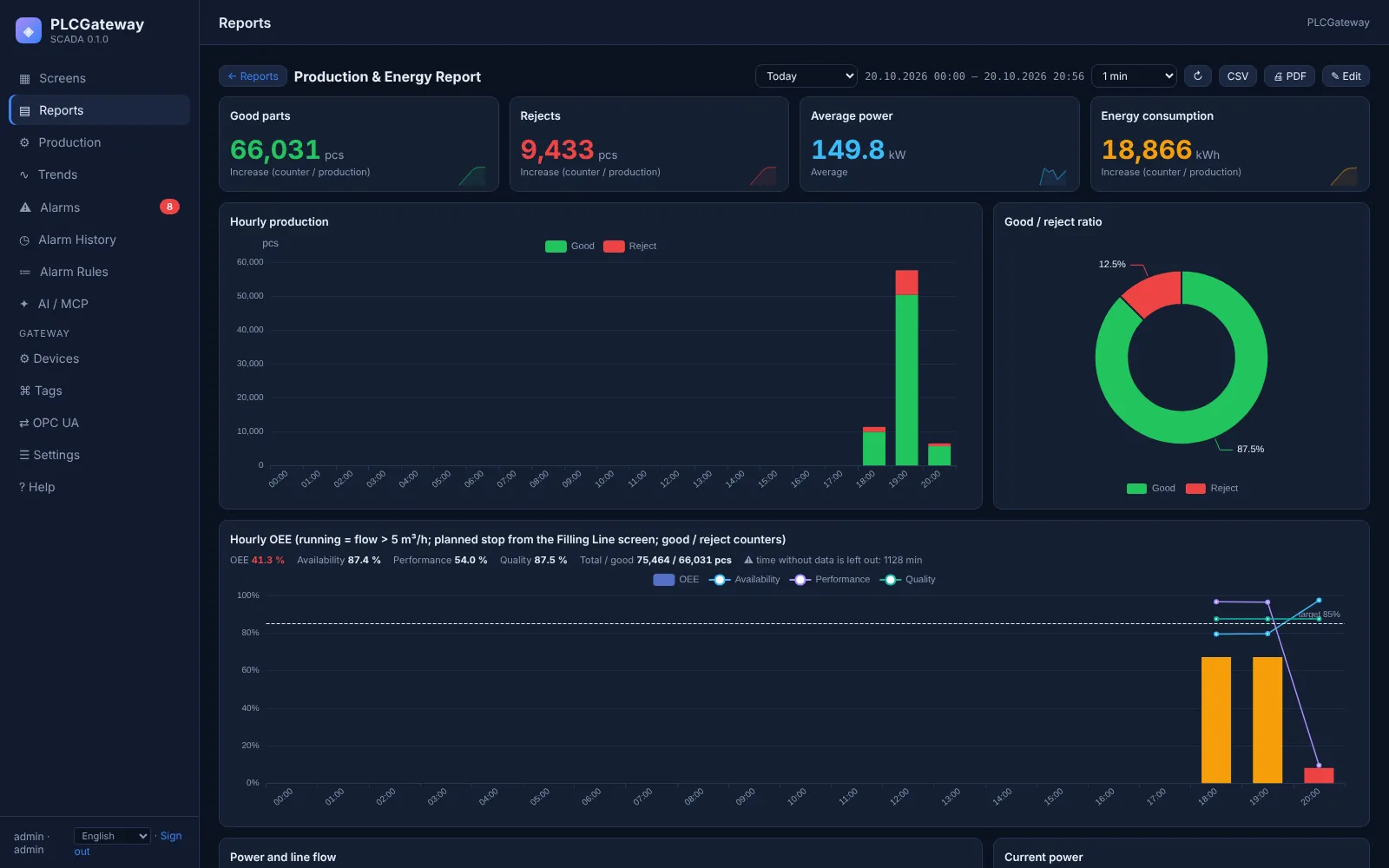
- Review dashboard with consumption, pareto, baseline and CUSUM widgets
What the energy review delivers
| Figure | How it is calculated | Where it appears |
|---|---|---|
| Consumption per meter and carrier | Counter increase or integrated rate per calendar period, cost and CO2 from the factors | Energy page, dashboard widget, report section, REST and MCP |
| Significant energy uses | Pareto of the meters by cost or quantity with the cumulative share | Energy page, dashboard widget |
| EnPI | Energy divided by the driver of the period | Virtual tag, dashboard, report |
| Baseline and expected energy | Least-squares line E = a + b × driver over the reference period, r² and residual spread | EnPI editor, dashboard, report |
| Saving, CUSUM, deviation | Expected minus actual per period, cumulative, and the deviation in percent against the target | Dashboard, report, alarm |
Energy and buildings: common questions
Can an AI assistant set up and run the energy management?
Yes. Over MCP the assistant defines meters with cost and CO2 factors, creates EnPIs against production or degree days, fits the baseline over a reference period, builds the energy review dashboard and answers questions such as 'how much did line 1 consume last week and what did it cost' or 'is the specific energy of the extruder above the baseline' from the real history. Configuration needs administrator rights; questions need only viewer rights.
Does PLCGateway support IEC 61850 and IEC 60870-5-104?
Yes. PLCGateway includes an IEC 61850 MMS client for protection relays and bay controllers and an IEC 60870-5-104 client for substations and RTUs, as well as DNP3 for outstations and BACnet/IP for building automation. All four are native drivers available in Connect, SCADA and Embedded.
Can it do ISO 50001 energy management?
PLCGateway covers the data side of ISO 50001: energy meters with cost and CO2 factors, significant energy uses, energy performance indicators with a regression baseline against production or degree days, expected energy, savings, CUSUM and deviation alarms, an energy review dashboard and an energy section in the scheduled reports.
Where do the meter values come from?
From any tag of any protocol: Modbus energy meters, M-Bus gateways, IEC 61850 or IEC 104 feeders, BACnet building meters, OPC UA servers or a PLC that already totalises the energy. Rates such as kW are integrated over time when there is no totaliser.
What about Profinet and EtherCAT?
Profinet IO and EtherCAT are real-time layer-2 fieldbuses that need a dedicated master stack with direct network card access, which does not belong in a gateway that runs next to other software. Their devices are reached through the PLC that controls them (for example over S7) or through the Modbus TCP or OPC UA interfaces most of them offer.
Bring your substation or building online
Tell us which relays, meters or HVAC controllers you have; we connect them to the demo plant and show the energy review with your figures.