Allen-Bradley EtherNet/IP to OPC UA
PLCGateway reads Logix controllers over EtherNet/IP and serves their tags from an OPC UA server, so MES, SCADA and historians connect without RSLinx, DCOM or a Windows OPC server.
The classic route from a Logix controller to other systems runs through RSLinx and OPC DA, which ties the installation to Windows and DCOM. PLCGateway replaces that chain: it browses and reads the tags over EtherNet/IP itself and offers them as OPC UA variables with modern security.
It runs on Windows or Linux, also on a small device in the control cabinet, and the same OPC UA endpoint carries the Siemens, Modbus or Mitsubishi devices of the line.
- Source
- Allen-Bradley EtherNet/IP (CIP)
eip_logix - Connection
- EtherNet/IP · TCP 44818
- Target
- OPC UA
- Writing
- yes
Set it up in five steps
Add an EtherNet/IP device with the IP address of the controller or its Ethernet module.
For ControlLogix enter the route path (for example 1,0 for the CPU in slot 0); Micro800 needs none.
Open the tag browser, select controller or program tags and add them in one step.
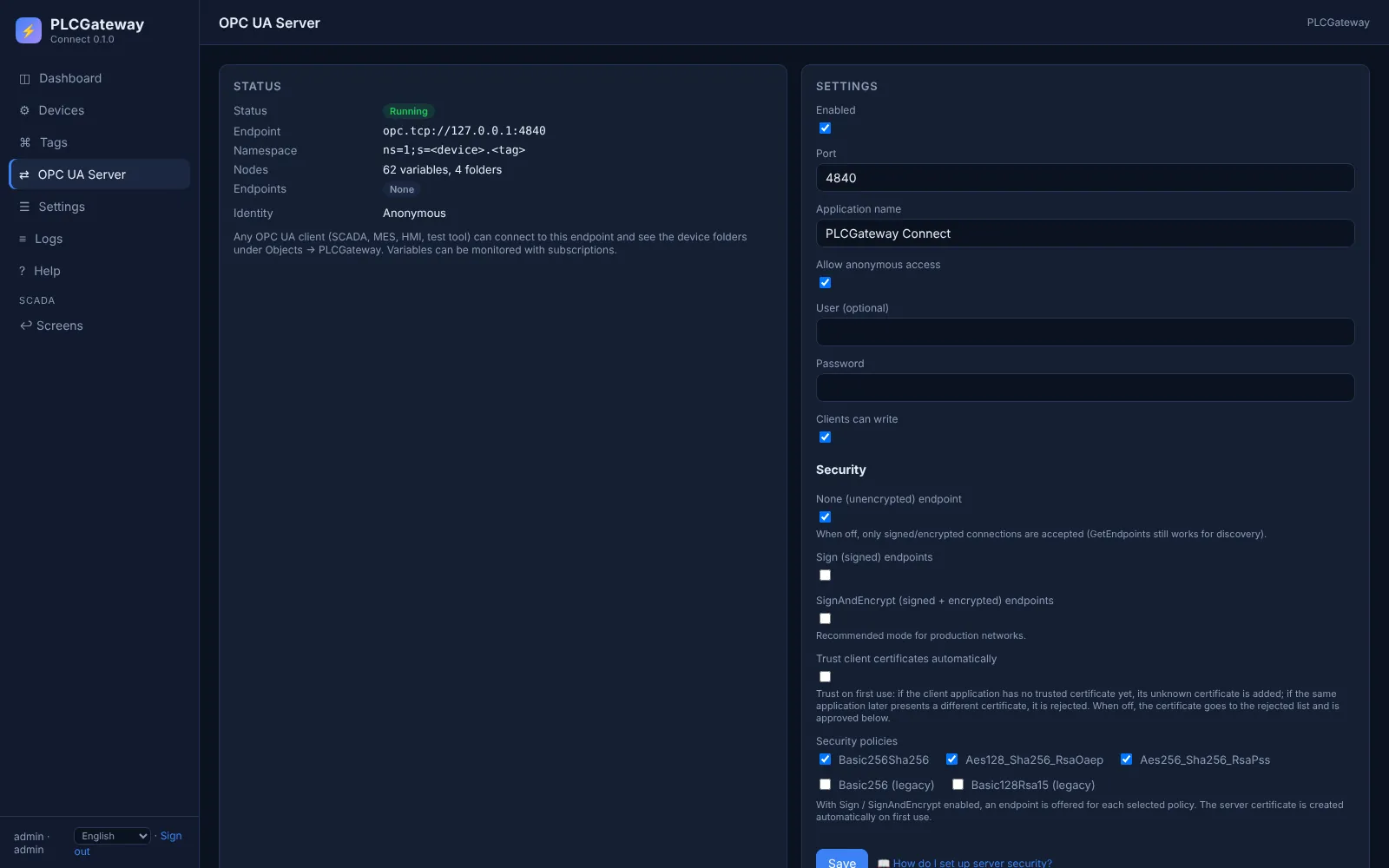
Open Gateway → OPC UA and choose the security modes and whether clients sign in anonymously or with user name and password.
Connect your OPC UA client (UaExpert, an MES, a SCADA) to opc.tcp://<gateway>:4840 and browse Objects → PLCGateway.
Example: node ids in the OPC UA server
A device with the id filler1 and these tags appears in the address space as shown below. Names and values are examples.
| Tag | Address | Example value |
|---|---|---|
MotorSpeed | Motor_Speed | 1180.5 rpm |
PumpRunning | Line1.Pump.Running | true |
BottleCount | Program:MainProgram.Counter | 48213 |
OPC UA node ids
opc.tcp://<gateway>:4840
Objects / PLCGateway / filler1
ns=1;s=filler1.MotorSpeed   = 1180.5
ns=1;s=filler1.PumpRunning  = true
ns=1;s=filler1.BottleCount  = 48213
Every tag is a variable under Objects / PLCGateway / device in namespace 1; clients read it, write it and subscribe to its changes.
The OPC UA server in PLCGateway
Every tag becomes a variable in PLCGateway's built-in OPC UA server, so MES, ERP, SCADA and historians use one standard endpoint instead of each controller's own protocol. Clients browse the devices and tags, read, write and subscribe to value changes.
The server offers the security modes None, Sign and SignAndEncrypt with automatically generated certificates; clients sign in anonymously or with user name and password.
- One endpoint (opc.tcp, port 4840) for all devices and protocols
- A folder per device and a variable per tag, with description and unit
- Subscriptions with data-change notifications; writing only where the tag allows it
- Client certificates are approved in the web interface
Controllers and devices
Equipment that is typically connected with this driver.
Questions and answers
Which controllers are supported?
ControlLogix (1756-L7x, L8x), CompactLogix (1769-L3x, 5069-L3xx, L4xx), GuardLogix and Micro800 (Micro820, 850, 870) over EtherNet/IP.
How do the controller tags map to OPC UA?
The controller tag, for example Line1.Pump.Running, is the address of a PLCGateway tag; the name you give that tag appears as the OPC UA variable in the folder of the device.
Can OPC UA clients write Logix tags?
Yes, when writing is allowed in the OPC UA server settings and the tag is not read only. Single bits of integers are written with a read-modify-write service.
Connect your machines
Tell us which controllers you run; we show you PLCGateway with your own addresses.
Product and model names are trademarks of their owners. They are named only to show which equipment the drivers communicate with; PLCGateway is not affiliated with these companies.